
The Rise of the Agent: Why 2026 is Digital Marketing’s "Architectural" Moment
By: Ray Estevez
Introduction: The 2026 Digital Marketing Maelstrom
If you feel like you are living in a digital marketing version of Everything Everywhere All at Once, you are not alone. In late 2025, we witnessed “outlier weeks” that felt like a localized singularity: OpenAI launching instant checkouts within ChatGPT, generative video apps reaching cinematic parity, and visual agent builders dropping in a single seven-day window. For the modern CMO, it is a violent re-architecting of the profession.
For CMOs, it’s about “figuring out this whole AI thing” before their competitors do. This has triggered a state of temporary “chaos”. While 90.3% of marketers are experimenting with AI agents, most are still stuck in the “multiverse” of isolated proofs-of-concept (POC). As we enter 2026, the mandate is clear: move at lightning speed, go beyond experimentation, and embrace the architectural shift. This is a join-or-die moment for the CMO’s career.
From Efficiency to Effectiveness: The Maturity Pivot
In 2025, the primary driver for AI was the “low-hanging fruit” of efficiency. According to the World Federation of Advertisers (WFA), 70% of members prioritized Generative AI to drive back-end automation and cost savings. But the era of the “efficiency pilot” is ending. 2026 marks a critical maturity pivot: shifting from cost-cutting to measurable marketing outcomes and business growth.
Sustained growth in an agentic world requires moving beyond simple automation. AI is transitioning from a productivity tool to a primary differentiator. Brands are now redesigning their operating models to ensure AI isn’t just a “feature” on the periphery but the core engine delivering measurable business impact.
“In 2026, AI is going to be a differentiator and used for sustained growth.” Alexis Karsant
The Three Domains of the “Agentic Era”
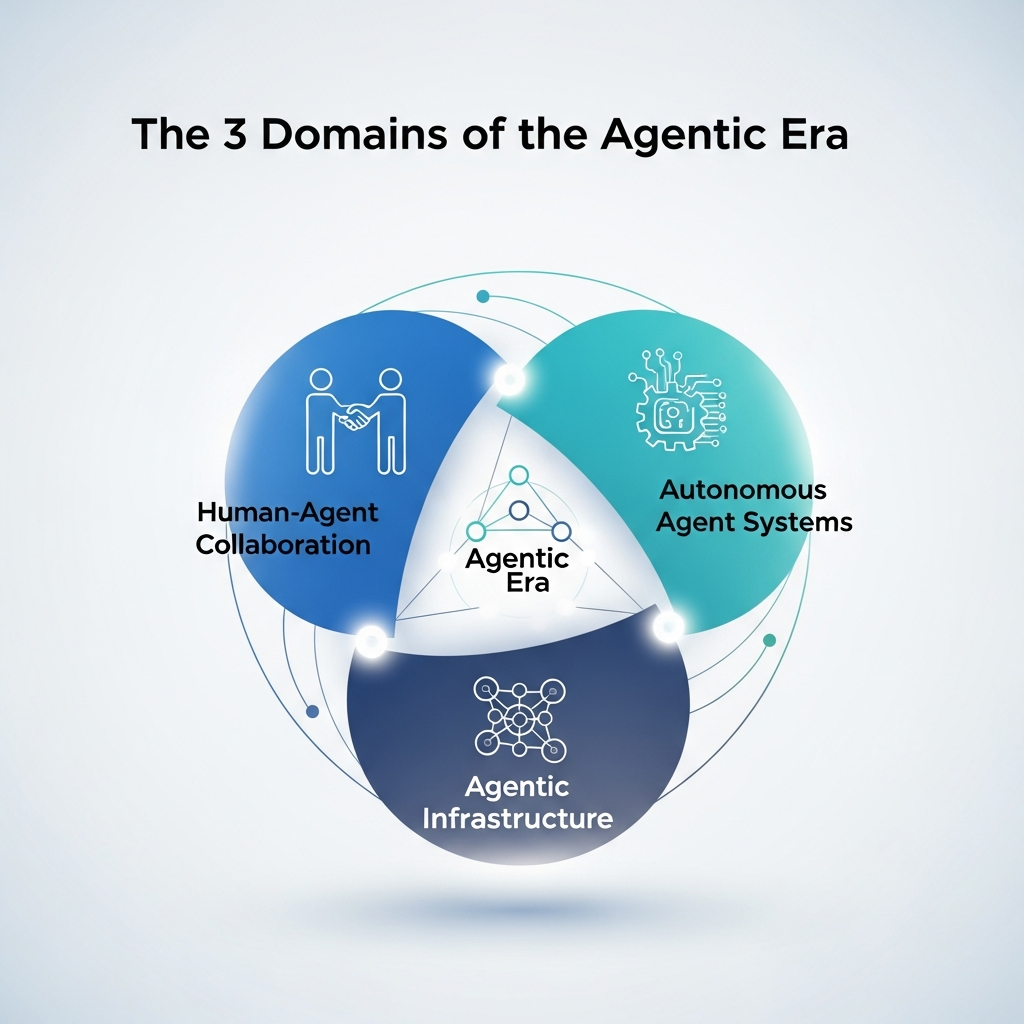
The “chatbot” is so 2025. We’ve moved into an era where AI possesses the reasoning to take semi-autonomous actions. To navigate this, leaders must categorize their strategy into three distinct domains:
- Agents for Marketers: Internal tools used behind-the-scenes to augment production, decisioning, and data analytics. These are the “backstage” workers under the brand’s total control.
- Agents for Customers: Brand-controlled interfaces (shopper concierges) that interact directly with buyers. Currently, B2C organizations are leading the charge here with an 83.3% adoption rate, compared to 71.6% in B2B.
- Agents of Customers: Buyer-side agents (customer’s personal AI assistant) that intermediate the buyer’s journey.
The “Agents of Customers” domain represents the most significant strategic risk. As buyers use AI to research and negotiate, brands risk being relegated to a “glorified fulfillment service” bypassed by the customer’s own assistant. To solve this, brands must adopt protocols like MCP (Model Context Protocol) and A2A (Agent-to-Agent) standards, allowing the brand’s MARTECH to “talk” directly to a buyer’s agent.
“Things become agentic when you combine the ability of AI models to reason with tools and perform actions in the external world.” — Tejas Manohar
Search is Evolving into a “Topic Ecosystem”
Traditional SEO is currently undergoing a violent re-architecting. McKinsey data reveals that 50% of consumers already use AI-powered search, with a staggering $750 billion in consumer spend projected to flow through AI channels by 2028. This shift necessitates a move toward Generative Engine Optimization (GEO) and Answer Engine Optimization (AEO).
“Brand citations” have officially replaced “backlinks” as the gold standard of authority. Why? Because large-language-models (LLMs) value high-intent human discourse found on platforms like Reddit, LinkedIn, Quora, and YouTube over static web pages. These platforms are the new “hubs of truth” where AI engines mine for human consensus. If your brand isn’t being cited in these high-authority human hubs, you don’t exist in the AI’s answer.
Context Engineering is the New Data Gold Standard
We are moving beyond the 24/25 era of simple prompt engineering into the sophisticated discipline of “Context Engineering.” In 2026, AI is a commodity; Context is your only true differentiation. The shift is architectural: moving from Systems of Record (static data) to Systems of Knowledge (the data layer) and finally to Systems of Context (the agent layer).
The critical breakthrough is AI’s ability to interpret unstructured data. 2026 belongs to the brand that can weaponize call transcripts, emails, and brand guides. Your Cloud Data Warehouse is no longer just a storage unit; it is the “Royal Treasury” of the brand.
A successful context strategy rests on four pillars:
- Presence: You must have the data collected or traded and categorized.
- Data Quality: Data must be clean and factual to prevent hallucinations.
- Accessibility: Resources must be pragmatically connected across the MARTECH stack.
- Application: Data must be applied to specific, high-intent destination use cases.
The Rise of “Vibe Coding” and the Organizational Architect
A radical shift for 2026 is “Vibe Coding“. This is the use of natural language tools like Bolt, Lovable, and Replit to enable non-engineers to “chat an app into existence.” While this democratizes creation, it presents a massive data governance risk.
The CMO must become an Organizational Architect. When anyone can build an app or generate content, the leader’s value shifts from providing resources to governing the brand’s technical logic and voice. You must ensure that “Vibe Coding” results in an “ownable and distinctive” brand voice rather than a fragmented digital mess.
The Regulatory Mainstream and AI Transparency
AI has moved firmly into the regulatory mainstream. Following the China/EU model, we are seeing requirements for influencers to hold verified credentials before discussing complex topics. Global regulators are also hard-wiring AI transparency into law, making disclosures for AI-enhanced content a legal baseline.

Conclusion: Beyond the Pilot Phase
The statistics are sobering. While 90.3% of marketers are experimenting with agents, only 23.3% have deployed them into full production. The bridge between these two numbers is the “Architectural Shift.” The next twelve months will separate the “resource managers” from the “architects” who can balance human creativity with machine logic.
As you finalize your 2026 digital marketing roadmap, ask yourself: In a world where customers use AI to filter your messages and agents to negotiate your prices, is your brand’s voice human enough to break through the noise?